Saturday, December 13, 2014

Hey Stranger!

It has been 6 months since my last post and I have been a busy bee trying to implement all of the things I last talked about. In my last post I shared with you about my wonderful trip to the 2014 IDEAS conference and everything that I learned about and planned to introduce into my classroom. Since then, I have attended 3 other trainings/conferences and have even more ideas to share! But first things first, I want to update you on my progress with interactive/sensory books.

Before I took my two-year break from teaching, I had several interactive/sensory books in rotation but those didn't seem to make it into my classroom when I began teaching again and I sort of forgot about them. This is one reason why I love going to conferences or trainings- I not only learn new strategies but I also have my memory jogged on things that I already know but am not putting into practice.

I'm trying not to overwhelm myself with creating a ton of these interactive/sensory books this year so I am keeping it simple right now. If you remember, these were some of the incredible ideas that I saw this summer at training:


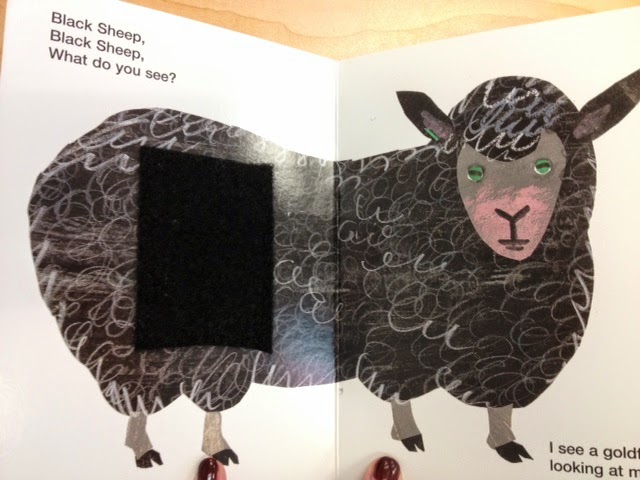
Beautiful! I plan on making ONE- yes, just one of these this year. Right now, I am adapting board books to make them into interactive/sensory books. Here are a few of the ones I have done this year with the units I have taught:


This interactive book allows for students to identify the front of the book and then the main characters on each page. I usually pass out the pictures beforehand and then as I read about the character in the book, students will match their visual to one in the book.


This interactive book allows students to identify how many lights are on each page and match the numeral with the number in the book. 


I made a simple sensory book using my favorite unit that I teach, Brown Bear.


I literally made this one in 5 minutes one Friday afternoon. It is super simple but I think it gets the job done. I used items that I found in my closet such as foam, cotton balls, ribbon, velcro, pipe cleaners, etc. and hot glued them into the book. I hope to make a lot more of these in the future. 

There are so many great ideas out there for creating interactive/sensory books. These are some of my favorite pinterest boards: this one, this one, this one,  and this one! 

Saturday, June 7, 2014

These are a few of my favorite {IDEAS}:

I had the incredible opportunity to attend the Institute Designed for Educating All Students (IDEAS) 2014 Conference this week on St. Simon's Island. If you ever get the chance to attend this- definitely go. It was a game-changer for me and something that I hope to attend every year. Sometimes you just need to get together with a large group of people who do what you do and think like you think and bounce ideas off of each other. A lot of what I heard here was not new to me but helped me to think about things in a new way and come up with ideas of new techniques and strategies to use with me kiddos. Unlike other conferences I've attended in the past, IDEAS 2014 had a great deal of breakout sessions to choose from and (most of) the presenters weren't trying to push their own products. In fact, a great majority of the products & resources were freebies (!). I also liked that most of the presenters name-dropped the researchers behind the strategies so that I could ensure I was learning about evidence-based techniques. Here are a few of my favorite topics that were discussed this week:

1. Incorporating sensory techniques into instructional activities

Although I feel that I have a pretty strong understanding of how to use a variety of techniques in order to meet students sensory integration dysfunction needs, I tend to keep a separation between sensory & academic times. I allow for sensory breaks throughout the day but rarely use sensory materials in order to allow the students to better gain access to the academic curriculum. Jessie Moreau, from Gwinnett County Schools, was just one of the presenters who discussed this. She creates these incredible literacy notebooks using adapted books and adds detailed sensory materials along with additional visuals. I have seen a good bit of her stuff on the Resource Board before. Jessie's suggestion was try to create one book per school year. The overachiever in me is going to aim for two this year:)

Jessie Moreau's Books

2. Communication vs. Language

Jennifer Thomas from Houston County Schools did a great job presenting on Augmentative Communication in the classroom. One topic she discussed was the difference between communication and language. This is such a simple concept but one that I forget to distinguish between during my daily routine. I think that I put more of an emphasis with my students on tacting, labeling, acquiring new vocabulary, etc. (language) and less time on greetings, expressing needs, making choices, etc. (communication). She also introduced me to the term "core vocabulary." I have seen and used communication boards based on the Pixon Project but was not familiar with the terminology. Basically, the core vocabulary are the first words that toddlers use (ours would be paired with a visual of course). I spend a great deal of time in my classroom on non-core words (vocabulary words, labeling classroom materials, etc.) and very little time on those core words that are vital to actually being able to communicate. During Jennifer's presentation I got the idea of introducing a couple of core vocabulary words each week and using them in conjunction with our unit vocab words.


Example from BM Achieve

3. Core Words vs. Fringe Words

Thankfully Jennifer's presentation had introduced me to the concept of core vocabulary before I attended the Forsyth County's presentation of Communication: Peeled & Cored because they went into even greater detail on these basic core words. They use a large communication board with all of the core words pictured and then they add additional "fringe" words based on the unit/topic of discussion. This group discussed having a core board that the teacher used during activities and that the students could follow along (with para support) with their own personal lap boards. Another idea was to keep the core boards in a 3-ring binder and have strips of fringe words that can be flipped at the top.

4. Writing for Non-Writers

Most of the students in my classroom are not writing at this point so I was thrilled to see that my co-worker's mom was presenting with her colleague on this very topic. She gave me some great ideas- such as allowing students to choose between printed sticky notes to answer questions or to use them to order words to create a sentence but I was most excited about all of the materials ideas. I'll tell ya, these ladies must live at the Dollar Store. They had some wonderful ideas for using ordinary objects. For example, I plan to buy some acrylic picture frames that stand up for students to velcro their answers onto and cutting pool noodles to use as a sequence board.


5. Circus Time- Errr, I mean CIRCLE Time:)

My circle time can get a little wild at time so I am always up for new ideas. Gini Bramlett from Fannin County gave me several new ideas to try out with the kiddos. For one, I'm going to switch my attendance chart from saying school & home to use core words (here, away) and I'm also going to add teacher names and administrator names to the chart so that students are more familiar with those. One of the other attendees had the idea of pairing each day of the week with a specific texture and also using sensory materials when discussing the weather. Gini create a great smartboard file that she was willing to share with us all to take home and change as needed.

These presentations- and several others- gave me pages of ideas that I want to incorporate in my own classroom. I'm going to try to focus only on one idea at a time so that I don't overwhelm myself but I'll post as I work my way through on here with pictures and materials. IDEAS 2014= SUCCESS! While there were a couple of duds in the bunch, it was overall a really phenomenal week (the beautiful beach, delicious food, and fabulous friends didn't hurt either!).

Tuesday, November 26, 2013

Turkey FREEBIE

While using my turkey-themed interactive activities last week, I decided that I wanted to create some corresponding worksheets for my students to continue practicing the skills in an individualized grouping. I created these worksheets to go along and the kids did really great with them! We completed the SmartBoard activities during our circle time so they knew what to do and then we practiced the skills again at the end of their individual work times. These turkey unit worksheets are FREE over at my TPT store right now- enjoy!

Sunday, November 17, 2013

Gobble Gobble

This is such a fun time of year in our classroom! After our pumpkin unit, we focused on all things family. Last week I started introducing turkeys into the mix. We've been reading about Clifford's Thanksgiving and Arthur's Thanksgiving, making lunch sack turkeys, drawing pictures of what we are thankful for, and incorporating turkeys into all academic activities. I created this Smartboard file to practice letter, number, shape, and color skills with my kiddos. You can pick it up over at my TPT store for just $2!


Also- check out the sweet surprise my paras had for me when I got back from training the other day- so cute!

Wednesday, October 16, 2013

Toilet Training

My kids have a huge variety of toileting abilities this year- I have a couple who are completely independent, one who is toilet trained but still relies heavily on verbal prompting, one who is just starting the process, and then one who I am having great difficulty even getting him in the bathroom. I started the year with my normal toileting structure- potty visuals in the classroom to aid in transition to the bathroom, a wet/dry visual in the stall in the bathroom, and a visual schedule in the stall. These pieces of visual structure met the needs of most of my students- but not all.

I have struggled most of the year getting one of my students to actually transition from the classroom to the bathroom. Typically, he makes it into the pod and then sits down, refusing to move any further. Up until a few weeks ago, I was making the mistake of trying to correct his behavior once we got to the point of him sitting down. I had forgotten the most important step in behavior management- look at what is going on before the negative behavior happens and work to prevent this situation from ever occurring in the first place.

Around that time, we had a visit from one of the guys up at Emory Autism Center. They ran a few workshops and Q&A sessions, observed our program, and sat down with us to offer suggestions. While some of the information provided at the general workshops were a little introductory- it was wonderful for me to be reminded of several techniques and tools that I hadn't considered using with my current group of kiddos.


On the day that our program was being observed, we orchestrated it so that I could demonstrate the difficulty with transitioning my one little guy to the potty. Can you guess what happened? He transitioned to the potty without any problems! I should have known! Our friend from Emory was still able to observe my toileting routine with this kid and suggested that I needed even more structure than I was providing. While my minimal visuals and schedules were working with my other kids, this one was a very special case and required much more structure.

I am happy to report that my student is now transitioning to the bathroom about 80% of the time. We have yet to get him in the stall but this is a huge accomplishment. Baby steps, right? Here is what we are currently doing:

1. Check diaper to see if wet/dry. We use a visual in a corner of the classroom to do this. Hand-over-hand for him to indicate which. Hoping one day he will be able to communicate this with us.

2. If wet, use the potty picture to transition to the bathroom.

3. In bathroom, we have a changing area with a visual. First, change diaper, then reinforce pics are used.

4. Visual schedule is used while changing diaper.

5. Reinforcer is given in the bathroom. This is something I wasn't doing before but was recommended.

6. Washing hand visual schedule is used.

I am hoping that we can eventually move the reinforcers into the stall so that he will at least enter it, then later moving to sitting on the toilet for a minute, and so on. We are still a long way from this but we're looking for progress, not perfection!

In designing the visual structure for my toileting routine, I put together this pack. It includes 13 pages of visual schedules and structure to assist students still in diapers all the way to students who are toilet trained but require visual prompting. I hope you can find this one helpful!


Wednesday, October 9, 2013

Candy Corn Match Game

Several of my students are really struggling with the concept of representing a number of objects with a numeral. We've only covered numbers 1-4 so far this year and I've only introduced the concept of representing a number of objects with a numeral in the past few weeks. I know that they will all eventually make progress in this area but in order for that to happen it needs to be practiced constantly.

I've worked over the past week to create several unit-based tasks for them to practice these skills. Most of the kids are still working with numerals 1 & 2 but I'm going ahead and creating tasks up to 10 and 20. Here is a task created to go with our Halloween week-long unit that we'll do the last week of the month. I'll use these during individual teaching sessions and as they master they'll be placed in their work stations.

{Candy Corn Number Match Game}

Each candy corn will be laminated and cut into thirds. The student will be asked to match each numeral with the amount and number word. Click on the picture above to purchase the game.

Sunday, September 29, 2013

Classroom Choreography Part 5: Table Time

 
My students participate in table time activities three times during the day. As I showed in my schedule, the majority of our instructional day is comprised individual teaching sessions and a variety of stations. One of our stations is table time.

During the first rotation, table time includes the completion of a short unit activity. The activity is typically a unit themed worksheet and may include sorting pictures by size, cutting pictures apart, identifying the letter of the week, coloring a picture, etc. The students complete this activity individually with a parapro or teacher education student. The other students are rotating through the computer, play, reading, work stations, or listening center with another para's supervision.

During the second rotation, table time includes the completion of a variety of work tasks. These tasks are kept on two shelves within reach of the table. There is a huge variety of tasks- from simple fine motor to color matching to sequencing. Tasks are chose for the child based on their goals and ability levels. Usually, several tasks are placed at each seat at the table and the child or children rotate around the table as they complete each task. A para supervises this while the other students are rotating through stations.


{table time rotation}

{table time storage}


{simple table time tasks}
During the third rotation, table time includes the completion of a touchmath activity. One para reviews the touchmath numbers and assists some of the students in completing a touchmath worksheet. The other students rotate through stations or work with the other para at the Alphabeats station.